
Herpesvirus makes itself at home: remodeling the host-cell nucleus
Original story from the University of Jyväskylä (Finland).
Using advanced microscopy techniques and computational modeling, researchers have discovered how herpesvirus infection affects the host-cell nucleus.
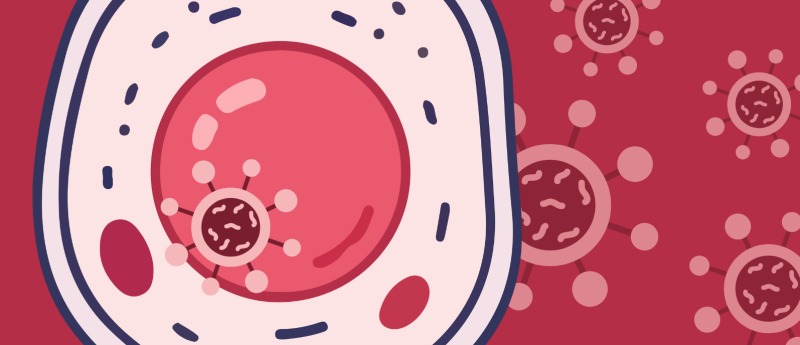
Researchers at the University of Jyväskylä (Finland), in cooperation with national and international research groups, have shown that DNA viruses infect cells and take over the host-cell nucleus, inducing dramatic structural modifications. Herpes simplex virus 1 (HSV-1) infection and the emergence of nuclear enlarged, low-density viral replication compartments lead to changes in nuclear volume, chromatin organization and the structure of nuclear lamina.
Understanding the softening of the nucleus enables early diagnosis
Researchers show that the infection remodels nuclear biomechanics, leading to dramatic softening of the nucleus. To understand the phenomenon, advanced microscopy, including cryo-soft X-ray tomography (SXT) and atomic force microscopy (AFM), and computational modeling were employed.
 ‘Negative viscosity’: the surprising force that propels cells and defies physics
By measuring viscosity in a group of cells, scientists have made a physics-defying discovery about how they move.
“Our mechanical simulations and in vitro experiments showed that a reduction in outward forces, such as actin cytoskeleton pull or osmotic pressure, is the most likely factor in nuclear softening,” commented Research Director Maija Vihinen-Ranta from the University of Jyväskylä.
The study sheds new light on virus-induced fundamental nuclear remodeling. “Modern science is increasingly seeking to identify the forces acting on cells that shape their biomechanics. Usually, these forces come from outside the cell. However, the changes caused by the viral infection take place inside the nucleus of the cell, thus shedding light on the influence of intranuclear forces on the mechanical changes in the nucleus,” concluded Vihinen-Ranta.
This article has been republished from the following materials. Material may have been edited for length and house style. For further information, please contact the cited source. Our press release publishing policy can be accessed here.