
CRISPR vs superbugs: new genetic technology dismantles antibiotic resistance in bacteria
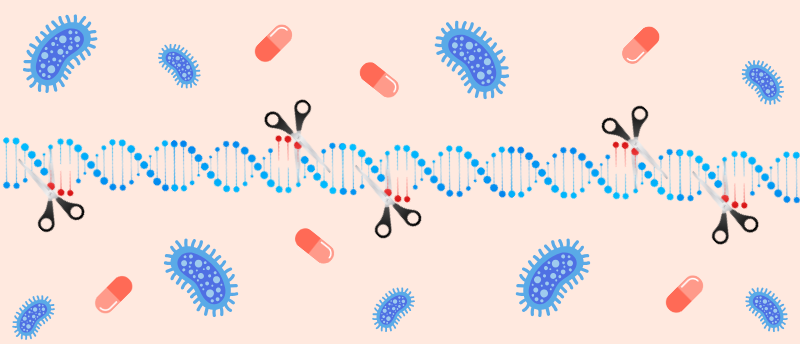
A novel CRISPR-based technology can spread within bacterial populations to eliminate antibiotic resistance.
In a potential breakthrough for tackling antibiotic resistance, researchers from the University of California, San Diego (CA, USA) have created a CRISPR-based genetic cassette that can spread between bacteria via conjugal transfer to inactivate their resistance genes. With clinical implications, as well as applications in microbiome engineering and bioremediation, the novel technology could prove beneficial for both human health and the environment.
Antibiotic resistance is a growing public health threat, currently responsible for around 1.27 million deaths worldwide. With bacteria evolving evermore inventive ways to evade drug treatments, it is essential that we develop new antimicrobials and innovative strategies to stop resistance in its tracks.
One promising approach involves using CRISPR to engineer genetic elements that can spread within microbial communities to eliminate antibiotic resistance genes. In a previous research effort, the team created an alternative CRISPR-based technology, called Pro-AG, which functions like a gene drive system to disrupt genes encoding antibiotic resistance factors by precise insertion of an sgRNA cassette into the targeted cleavage site.
Now, they have advanced this strategy by integrating Pro-AG into a single conjugative transfer system that enables the distribution of an anti-resistance gene cassette between two bacterial strains.
 Expanding the CRISPR toolbox: new mechanism could push boundaries of gene editing
Scientists have discovered a new CRISPR mechanism with precise activity, expanding the potential applications of the existing CRISPR toolbox.
This second-generation plasmid, pPro-MobV, includes two key arabinose-inducible Pro-AG components (λRed and Cas9); an sgRNA cassette targeting the bla resistance gene, which confers resistance to ampicillin; conjugation machinery, including genes required for plasmid maintenance, stability and for conjugation derived from the IncP RK2 conjugative system; an oriT site for transfer of these components to recipient bacteria; and chloramphenicol and gentamicin resistance genes.
The researchers introduced pPro-MobV into Escherichia coli Epi300 and performed a liquid conjugation assay using E. coli MG1655 as the recipient strain. In doing so, they demonstrated that conjugal transfer of the pPro-MobV system efficiently inactivates bla and reduces antibiotic resistance in recipient cells.
They also identified and characterized a complementary homology-based deletion process – a CRISPR-driven mechanism whereby sgRNA precisely targets plasmid DNA flanked by short direct repeats, resulting in the deletion of intervening sequences – that could be used to remove the gene cassette if required. Homology-based deletion could also be used to excise a variety of duplicated genetic elements that contribute to antibiotic resistance.
“With pPro-MobV we have brought gene-drive thinking from insects to bacteria as a population engineering tool,” explained study author Ethan Bier. “With this new CRISPR-based technology, we can take a few cells and let them go to neutralize [antibiotic resistance] in a large target population.”
Co-author Justin Meyer added: “This technology is one of the few ways that I’m aware of that can actively reverse the spread of antibiotic-resistant genes, rather than just slowing or coping with their spread.”