
Camel antimicrobials could get us over the hump of antibiotic resistance
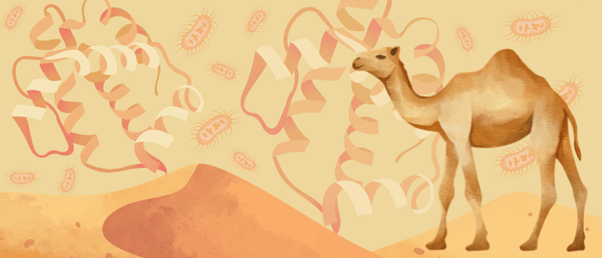
A trio of antimicrobial peptides that target multidrug-resistant bacteria has been identified from an unexpected (and amusing) source: camels.
Researchers from Sultan Qaboos University (Muscat, Oman) have discovered three new antimicrobial peptides in dromedary camels, offering hope for novel pharmaceuticals to combat drug-resistant bacteria.
Antibiotic resistance is a growing global health threat, and in order to counter it, potent new antimicrobials are urgently needed. Conventional antibiotics act via site-specific binding mechanisms, which are susceptible to resistance, hence the need for alternative options that exploit different routes of pathogen prevention.
Over the last 30 years, antimicrobial peptides (AMPs) have emerged as a promising choice. AMPs are a group of small bioactive proteins that form part of the body’s innate defense against microbes. Thanks to their broad activity against bacteria, they are widely touted as a surrogate for antibiotics. In mammals, the two primary AMPs are defensins and cathelicidins, small, cationic and amphipathic molecules that mainly kill bacteria by making pores in their cell walls.
 New tissue model may inspire drugs to treat liver disease
Two models more accurately replicate the physiology of the liver, offering a new way to test treatments for fat buildup.
In the recent study, scientists aimed to identify and functionally characterize AMPs in Camelus dromedarius, as camels have a robust innate and adaptive immune system and respond better to bacterial and viral infections than other domesticated animals. Despite advancements in camel immunology, the role of AMPs is yet to be explored.
Using in silico and experimental approaches, the team set about rectifying this. They combined bioinformatics with validation studies, including colony-forming assays, membrane permeability tests, circular dichroism spectroscopy and electron microscopy, to reveal the characteristics and function of camel AMPs.
Three camel cathelicidin peptides were identified: CdPMAP-23, CdPG-3 and CdCATH. Two of these – CdPG-3 and CdCATH – demonstrated significant antibacterial activity against Gram-positive and Gram-negative strains, including Methicillin-Resistant Staphylococcus aureus and multidrug-resistant Escherichia coli.
Both AMPs caused bacterial membrane damage and leakage without high toxicity. At low concentrations, they exhibited low to moderate lytic activity against red blood cells in humans, camels and chickens, supporting their safety for further development.
“These findings enhance our understanding of the unique features of dromedary camels, their innate immune system, and its components,” the authors concluded.
They also “highlight the potential of CdCATH and CdPG-3 as antimicrobial peptides against antibiotic-resistant strains […], paving the way for further research in this area.”