
Diamond in the rough: slaughterhouse wastewater proves unlikely source for food hygiene breakthrough
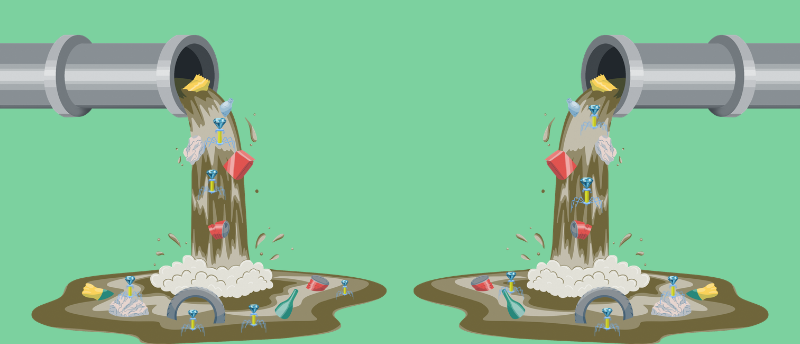
A novel bacteriophage isolated from slaughterhouse wastewater and poultry farm effluent could be the key to protecting against Salmonella poisoning.
Fishing through slaughterhouse wastewater sounds like an unpleasant task, but it’s one that a team of researchers from Gansu Agricultural University (Lanzhou, China), led by senior author Huitian Gou, has undertaken in order to identify a promising solution to Salmonella decontamination.
Salmonella is a key contributor to food poisoning cases and poses a considerable food safety risk to society, with a 2023 screen of 16% of the US population confirming over 7000 cases of Salmonella poisoning, with an alarmingly high hospitalization rate of 29%. In efforts to keep infection at bay, poultry farmers ply their livestock with antibiotics, but this presents its own issues, accelerating the development of antimicrobial-resistant strains.
Salmonella’s formation of tightly packed biofilms helps protect them from chemicals and cleaning materials, making a move away from pharmacological solutions towards increased sterility and food hygiene unrealistic. So, what is the solution?
Bacteriophages, viruses that prey on bacteria, present a promising natural solution for this issue. The FDA (MD, USA) has labeled numerous lytic phages ‘generally recognized as safe’ and previous research has demonstrated the effectiveness of certain phages at reducing Salmonella populations on chicken skin. However, their real-world efficacy across the spectrum of food systems has yet to be demonstrated.
To address this shortfall in evidence, the team set out to identify a novel phage strain, thoroughly characterize it and test its performance in close to real-world settings. First, they used the double-layer agar assay protocol to screen for bacteriophages present in the wastewater of poultry farms and slaughterhouses with lytic activity against common Salmonella strains.
This approach highlighted the novel lytic phage W5, which displayed a potent effect against nine Salmonella serovars. Morphological and biological characterization, involving whole-genome sequencing with the PacBio (CA, USA) Sequel II platform, determined that W5 is a Cornellvirus and that the phage is stable up to 50 °C and across a pH range of 3–13.

Nanoplastics may put Salmonella on the offensive, compromising food safety
Nanoplastics can interact with Salmonella, potentially affecting food safety and human health.
Crystal violet staining and confocal laser scanning microscopy were used in parallel experiments to determine the ability of the phage to both disrupt the formation of biofilms and to break up established ones. This was assessed in a range of food matrices, including pasteurized milk, raw pork, liquid whole egg and eggshell surfaces at different developmental stages at 4 and 30 °C. Both approaches demonstrated the ability of W5 to both prevent the formation and break up established biofilms, effectively eliminating Salmonella, with optimal performance at 30 °C.
Field emission scanning electron microscopy demonstrated the success of W5 at disintegrating biofilms on food contact material surfaces, with consistently strong performance, but with optimal performance changing based on temperature, biofilm maturity and material surface.
Commenting on the success of this study, Gou declared that the team had “discovered a safe and highly effective natural virus (bacteriophage W5) that functions like a precision-guided missile, capable of eliminating harmful Salmonella on various foods and packaging materials, showing great potential as a novel guardian for food safety… Genomic analysis further confirms its safety profile, as it lacks virulence and antibiotic resistance genes.”
The team further highlights that, as a natural biological entity, W5 offers a green solution to decontamination, reducing the need for harsh chemicals.
“We firmly believe that phage W5 holds immense potential for seamless integration across the entire farm to fork supply chain. It can be incorporated into multiple critical stages – for instance, as a feed additive in livestock farming, a surface disinfectant in meat processing plants or even a preservative spray for fresh produce at the consumption end,” Gou added. “We eagerly look forward to collaborating with industry partners to translate this effective green solution from the laboratory to the market, working together to safeguard food safety.”