
Flip the switch: phototherapy combats drug-resistant bacteria
Original story from The Francis Crick Institute (London, UK).
Using phototherapy to combat antibiotic-resistant bacteria is a step forward in the new era of ‘antibiotic rescue’.
Lars Stevens-Cullinane works in a dark room. But he’s not processing negatives and printing photographs on light-sensitive paper; he’s testing whether brief flashes of light can make drug-resistant bacteria sensitive to antibiotics.
“We’re borrowing a technique from cancer drug discovery, where small molecules are used to degrade specific proteins,” shared Lars, a scientist in the Biological Inorganic Chemistry Laboratory at the Francis Crick Institute (London, UK).
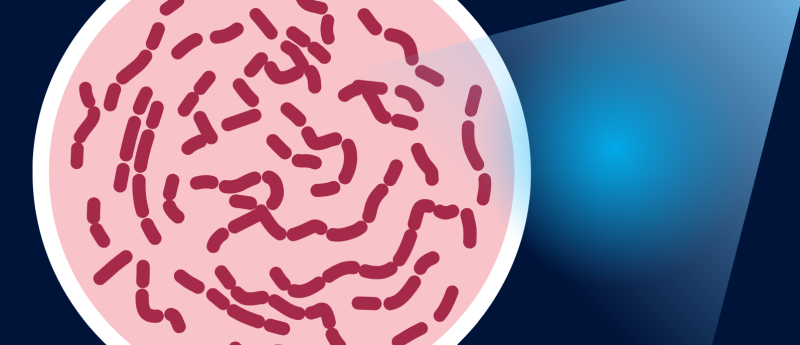
Rather than small molecules, Lars is using light-sensitive metal complexes to destroy parts of E. coli bacteria that make them resistant to antibiotics. “These complexes are harmless to the bacteria in the dark, but a big problem for them in the light,” he explained.
Antimicrobial resistance is a growing global problem, linked to 4.7 million deaths in 2021, a figure that’s set to nearly double by 2050. A large proportion of infections are caused by Gram-negative bacteria like E. coli, which have tough cell walls that block the entry of drugs, meaning fewer treatment options are available.
Jeannine Hess, who leads the lab at the Crick and lectures at King’s College London (UK), is focused on tackling this problem. “Many new antibiotics are improved versions of previous drugs, attacking bacteria in a similar way,” she commented. “But making different antibiotics from scratch is challenging and time-consuming. It’s clear we need new strategies, and we think innovative chemistry could hold the answer.”
 Let there be light: gene therapy targets cancer cells’ mitochondria
A light-induced gene therapy can damage cancer cells’ mitochondria, triggering widespread cancer cell death.
A precise target
In a recent study, Jeannine and Lars focused on an enzyme only found in drug-resistant bacteria, NDM-1, which breaks down commonly used ‘beta-lactam’ antibiotics like penicillin.
“We designed a chemical tool, ‘Ru1’, composed of a light-activated ruthenium metal complex attached to an organic molecule, or ‘ligand’, that binds to NDM-1,” explained Lars. “The metal complex is exposed to blue light, causing it to produce molecules called reactive oxygen species that cause damage to NDM-1.”
Through a series of experiments in purified proteins, the team showed that Ru1 damages NDM1’s active site, blocking its ability to destroy antibiotics – and it does so a hundred times better in the light. As soon as the light is switched off, Ru1 can no longer cause damage and can be used again.
E. coli can’t hide from the light
The next step was to test if Ru1 works in live E. coli. “Although Ru1 did partially inactivate NDM-1 in the live bacteria in the dark, it was thirty times more effective in the light, showing our targeted approach works,” explained Lars.
Finally, the researchers showed that Ru1 can effectively sensitize E. Coli to an antibiotic called meropenem. “At the maximum concentration tested, Ru1 increased the activity of meropenem by 53 times,” shared Lars. “Importantly, it didn’t show any toxicity to human cells.”
For Jeannine, this is proof that targeting specific proteins using phototherapy holds promise, but there’s a lot more work to do.
“This is the first time we’ve used phototherapy for this challenge, so we’d need to see how it works in an animal model next,” she concluded. “And, as blue light can’t penetrate deep into the body, it most likely would be used for skin infections, dental work or sterilizing medical equipment, rather than treating internal infections.”
Lars agreed that the new method might offer a potential alternative to the slow process of developing drugs from scratch, adding: “We hope that it becomes a versatile tool, allowing us to target other proteins of interest in the antimicrobial resistance field or beyond.”
This article has been republished from the following materials. Material may have been edited for length and house style. For further information, please contact the cited source. Our press release publishing policy can be accessed here.