
Give peas a chance: vitamin B12-fortified salad could address growing global deficiency
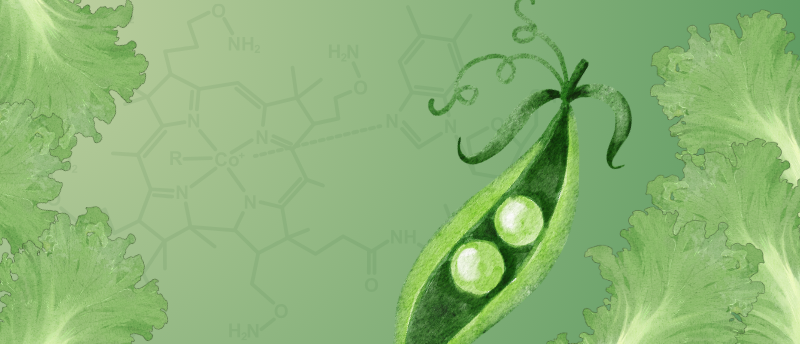
A pea-powered innovation that boosts vitamin B12 in salad leaves may help address the growing global demand for the essential vitamin.
In a multidisciplinary study, researchers from the John Innes Centre, the Quadram Institute (both Norwich, UK), the University of Bristol and indoor farm specialists LettUs Grow (both Bristol, UK) have used advances in aeroponic technology to fortify pea shoots (Pisum sativum) with vitamin B12. In doing so, they hope to address a major public health need, delivering the recommended daily allowance of B12 within a single portion of pea shoots and offering a commercially viable approach for dietary supplementation that may also work in comparable crops.
Vitamin B12, also known as cobalamin, is the only essential vitamin absent in plants. It is produced by bacteria, and humans generally acquire it by eating animal-derived foods, meaning that those following vegetarian and vegan diets without sufficient supplementation are at risk of deficiency, symptoms of which include anaemia and neurological dysfunction. As well as dietary insufficiency, B12 deficiency can arise as a result of genetic factors, autoimmune gastritis, infections, parasites and recreational drug use.
Globally, B12 levels are in decline, particularly in populations consuming low amounts of animal-based foods and in older people. Tablets are one solution; however, they may not facilitate optimal absorption, hence the drive for new, bio-accessible ways to sneak the vitamin into our food.
To investigate whether this was possible in salad, the team used aeroponics – a method of growing plants without soil that involves suspending roots in the air and misting them with a nutrient-dense solution. The technology used here was developed by LettUs Grow to supply the roots of pea shoots – chosen for their desirability to growers – with an aerosol supplemented with a form of B12 called cyanocobalamin.
 Protein made from carrot waste could be key to tasty veggie gains
Feeding fungi plant remnants produces a tasty protein that could fortify vegan and vegetarian diets.
Plants were exposed to a range of aerosolized cyanocobalamin concentrations at various growth stages and cultivated for 8 days, before being harvested for B12 quantification using liquid chromatography–mass spectrometry (LC-MS). At the same time, the researchers performed an existing seed-soaking method as a control.
Based on the resulting data, the team calculated the quantity of pea shoots needed to obtain the US adult recommended daily allowance of vitamin B12 (2.4µg/day). At the greatest aerosolized cyanocobalamin concentration tested, this was 18g. In contrast, it would be necessary to consume over 1.2kg of pea shoots to obtain the same amount of B12 from plants generated using the seed-soaking method.
When they looked solely at B12 in the leaves of pea shoots, the scientists found that those that underwent the aeroponic approach consistently accumulated more than the quantity of B12 that is necessary to deliver the recommended daily allowance within 15g (a single serving) of plant material.
In separate experiments, the researchers studied the senescence of the leaves while refrigerated for up to 30 days, keeping tabs on the amount of electrolytes leaking from plant tissue, their chlorophyll content and maximum photosynthetic efficiency. This revealed that the fortified crops maintained their shelf life, while LC-MS showed that B12 content wasn’t altered, even through an extended period of cold storage, both of which are essential for the crop to succeed commercially.
Moreover, simulated human digestion experiments confirmed that the B12 in the fortified pea shoots is accessible for absorption.
“The beauty of this work is how it marries high tech and low tech in such a cost-effective way. Pea shoots are literal sponges for B12, while vertical farms provide a controllable environment in which we can tailor its uptake by the plants,” the study’s first author Bethany Eldridge lauded.
“This method diversifies ways of getting B12 naturally into your diet, especially if you are not consuming meat and dairy as vegans or vegetarians, or if you are consuming meat and dairy in smaller quantities as part of a flexitarian diet […] If we can find a variety of ways that we can get it into food in a bio-accessible way, then that is exciting.”