
Curious raccoons solve puzzles just for the fun of it
Original story from the University of British Columbia (Vancouver, Canada).
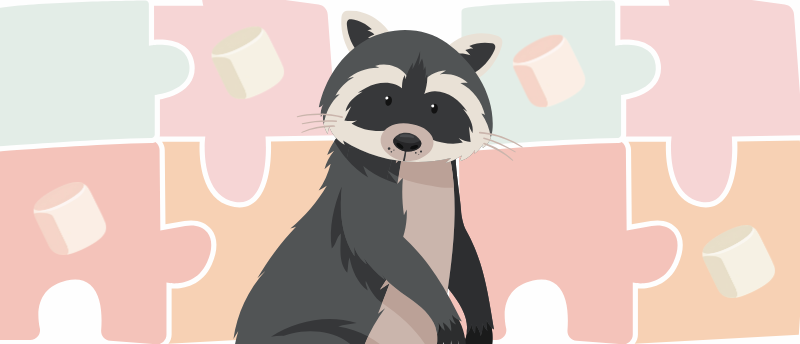
Raccoons solve puzzles even without food rewards, suggesting they are driven by curiosity and information-seeking.
They raid compost bins, outsmart latches and sometimes look gleeful doing it. A new University of British Columbia (Vancouver, Canada) study in Animal Behaviour suggests raccoons may not just be opportunistic – they may be genuinely curious.
Researchers Hannah Griebling and Sarah Benson-Amram found raccoons continued solving puzzles long after retrieving the only food reward available. This behavior reflects intrinsic motivation rather than hunger and is described as ‘information foraging’, because no additional food was given for continuing.
Nine ways in – and they kept going
Researchers used a custom multi-access puzzle box with mechanisms such as latches, sliding doors or knobs. The box had nine entry points, grouped as easy, medium and hard. In each 20-minute trial, the puzzle box contained a single marshmallow, yet raccoons often continued opening new mechanisms after eating it, a clear sign of information-seeking.
“We weren’t expecting them to open all three solutions in a single trial,” exclaimed Griebling. “They kept problem solving even when there was no marshmallow at the end.”
When risk rises, raccoons play it safe
When solutions were easy, raccoons explored broadly, trying multiple openings and varying their order. As task difficulty increased, they favoured a dependable solution – but still explored multiple solutions even at the hardest level, showing flexible problem-solving.
Griebling added that the pattern reflects a classic trade-off between curiosity and effort or potential risk. Raccoons adjusted strategy based on perceived cost and risk, mirroring decision-making frameworks in other animals and humans.

Teaching an old dog new tricks: ‘gifted’ canines learn words by overhearing their owners
Choose your words carefully around your canine companion: a group of ‘gifted’ dogs can learn new names by eavesdropping on their owners.
“It’s a pattern familiar to anyone ordering at a restaurant,” she continued. “Do you order your favorite dish or try something new? If the risk is high – an expensive meal you might not like – you choose the safe option. Raccoons explore when the cost is low and quickly decide to play it safe when the stakes are higher.”
Built for urban life
The findings help explain why raccoons thrive in urban centres like Vancouver. Their success could be attributed to the cognitive and physical traits that suit urban life.
Their forepaws, rich with sensory nerves for foraging in streams, are well suited to manipulating latches and handles – often the same kinds used by humans. Solving problems for information, not just food, may give them an advantage in complex environments, helping them access garbage bins or other food sources. Vancouver’s greenspaces, waterways and generally tolerant public provide near-ideal habitat.
“Understanding the cognitive traits that help raccoons thrive can guide management of species that struggle, and inform strategies for other species, like bears, that use problem-solving to access human-made resources,” explained Griebling.
Although the experiment involved captive animals at a research facility in Colorado, previous research suggests wild raccoons show similar problem-solving abilities, though researchers caution the behaviors may not be identical.
“Raccoon intelligence has long featured in folklore, yet scientific research on their cognition remains limited. Studies like this provide empirical evidence to support that reputation,” concluded Benson-Amram.
This article has been republished from the following materials. Material may have been edited for length and house style. For further information, please contact the cited source. Our press release publishing policy can be accessed here.