The BRAIN miniseries | Meet the neuroengineer building brain-monitoring devices and thriving communities
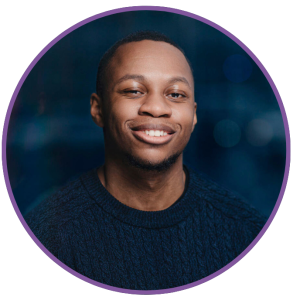 In our first episode of the BRAIN (Black Researchers Addressing Inequalities in Neuroscience) podcast miniseries, we dive into the research world of neuroengineering to gain an insight into the innovative devices being developed to monitor neurological disorders in addition to highlighting organizations that are playing a crucial role in supporting Black academics.
Our guest is De-Shaine Murray (left), a Wu Tsai Institute Postdoctoral Fellow at Yale University (CT, USA), working at the intersection of biomedical engineering and neuroscience to make devices to monitor disorders such as traumatic brain injury, stroke and brain cancers. He is also interested in using these same techniques for sweat monitoring, women’s health, and lab-on-a-chip applications. His academic career began at the University of Birmingham (UK) in chemistry, but has since moved into neurotechnology and bioengineering at Imperial College London (UK), the University of Cambridge (UK) and Yale. During that time, De-Shaine has been an instrumental community builder, founding organizations to support Black students in academia, participating in outreach and using his voice to create change in neuroscience.
[1:24] After reading a little bit about your academic background, I wanted to start by asking what made you want to conduct research in neurotechnology after completing your undergraduate degree in chemistry?
If I’m honest, I would put it down to being a bit of a random walk. I was always interested in the brain. The brain’s interested me from a young age, but I feel like in the UK, with regards to if you’re good at the sciences – I think it may have changed a bit now – but it can almost be that you end up getting pushed into one specific direction. I feel like even since being in the US, I’ve seen the different tracks with regards to the sciences that are really quite broad, and they allow you to do that from the undergraduate level. But for many, especially at the age of 16, 17, 18, when you’re making decisions about where you’ll go to university, it’s medicine. And that’s kind of where I ended up at that time.
But I did have this kind of thing in the back of my head about loving the brain. So, I originally went down the route of trying to become a medic, failed spectacularly and ended up in chemistry. And then it was through my undergraduate in chemistry that I actually found my way back to that. I was learning chemical principles, and the great thing about chemistry is they call it the middle science – it really connects to biology very well, it connects to physics very well. And it really is at that intersection already, it allows you to kind of explore lots of applications.
I really became quite applications minded, like what can I do with this chemistry? And then that’s kind of where I found out about sensors and then sensors became brain sensors. And I was like, ah, that’s right back where I wanted to be. And that’s how I ended up in neurotechnology.
[3:12] That’s awesome. That leads us on to our next question about OneProbe. So can you tell me about its working principle, the techniques you use to develop it, and what it can be used for?
OneProbe was essentially the marrying of biosensor technology and flexible electronics.
I was already in the biomedical sensors group at Imperial College London. This was under the leadership of Professor Martyn Boutelle. In that group, they made a range of biosensors to monitor metabolites in the brain – things like glucose, lactate, glutamate. And this was mainly for brain injuries, so things like traumatic brain injury or stroke. They came up with this pretty cool approach of these small needle microelectrodes that you could modify to make them specific for an analyte. And then you’d actually put them ex vivo, so they weren’t exactly in the brain, they were just attached by a microdialysis probe.
That was one half. And then there was the work that actually led me to being a visiting researcher at Cambridge, which was the flexible electronics. And this was from the bioelectronics lab, it was under the supervision of Professor George Malliaras, who essentially does a range of flexible electronics. But with me, it was more so a case of taking advantage of polymers such as parylene, specifically parylene C. The fact that you could use something called soft lithography. I guess we all take advantage of clean room processes, because if you look at the laptops we use, the phones we use, etc., they have chips that were made in a clean room with like semiconductor processes. That was kind of the repurposing of those techniques to then use it for soft devices, so for things that are a bit more flexible.
And that’s why I was then able to make OneProbe. So, it was the combination of those two things, and then using that to create a device that had electrodes that could monitor electrical activity, and then had chemical channels and the ability to sample by adding a membrane and things like that, so that could replace those microdialysis probes that were being used in Martyn’s lab.
So that was the combination and the working principle of OneProbe, with the eventual use of trying to really change how we monitor brain injured patients. Because currently in the intensive care unit, if you’ve ever been there, you’ll see so many machines, so many devices. And for what you were looking at, which was traumatic brain injury, and also for stroke, there were four, five, six devices that needed to be put into the brain in order to get all of these different measurements that would then be relevant for a doctor. But with that, you’re introducing injuries, because each one of those has to be placed directly into the brain, and usually separately or through a burr hole. So part of that was trying to make something that was a bit more applicable to the brain, something that was much softer, but also conformable, because the brain is curvilinear and has gyri and sulci. But then also bringing in the chemistry, because usually the chemical side of things is very hard to monitor in the brain, and usually gets ignored, but has very relevant information. A lot of the changes that happen electrically actually have underlying chemical properties, too.
[6:12] And I believe you’re also working to commercialize OneProbe. How have you found that process, and what direction are you taking to do that?
Tough, is the first thing. I think mine probably has been a convoluted route to say the least, for many reasons. I guess I could divulge that I see differences in the way that different institutions and also different countries do tech transfer. And I think that might be, I don’t want to say as a criticism, but just maybe an opportunity to improve.
For academia, when it comes to when we have ideas that we create, it’s like how we actually translate them, because there isn’t usually a clear route. And it really does depend on what institution you’re at as to the tech transfer office and their policies and what they believe is important, or what they would like to commercialize versus you having the vision to try and push something through.
So, during my time at Imperial, I did find it very hard to get to that route and to get towards commercialization. I then came across the pond and I was at Yale and told them about this work, which they were very interested in. So, I’ve definitely seen the differences there.
I would say currently, the work is a little bit in limbo, unfortunately, just because of institutional agreements and agreements between institutions. I think I’m still very optimistic about the possibility of getting things across the line. So, you’ll have to wait and see.
[7:35] For sure. How did OneProbe lead you into your more recent work on the NeuroProbe solution?
With OneProbe, the basis and background of the device was that it would be used within neurointensive care. Now, I kind of alluded to before that for monitoring the brain and specifically brain-injured patients, you need four, five, six different devices. All of those are made by separate companies and have their own acquisitional equipment. So, then you go into the ICU environment and you’re seeing 10 different machines that are not time aligned. They’re not working with each other.
I think that just causes a lot of chaos for a clinician. So, the idea behind the NeuroProbe solution was to really integrate those methods. So, this was and hopefully will still be the first probe that is quadmodal – four modalities into one. We were combining electrocorticography with intracranial pressure, temperature and brain tissue oxygenation. That was essentially the premise behind the NeuroProbe solution and bring that into one catheter that would then have one central computer that would then go to one display.
So, then you’d have four modalities in one and hopefully kind of reduce the clutter of that environment, but then just make it that little bit easier for clinicians to make informed decisions when they’re already in a highly pressured environment and they need everything to work then and there.
[8:55] I’d like to focus a bit more on your outreach initiatives to widen participation for Black students within academia. At the end of 2024, The Black PhD Experience was published. What was it like working on that book and what impact do you hope it will have on young people exploring further education in science?
The Black PhD Experience, with my co-editors, Dr. Wayne Mitchell, Dr. William Ackah, Dr. Madina Wane and Jacqueline Darkwa, was a real journey. It’s funny that it was published at the end of 2024 because the basis for that book started as early as 2018, but then the actual us trying to put that book together started in late 2020.
The context, a lot of where the background for that book actually came from, came from the African–Caribbean Research Collective (ACRC). And this was a community that I co-founded with a lot of my peers at the time who were also PhD students who had found out that in three years of research funding that was given by the UKRI – so this is publicly funded studentships – of, I think, 19,688 places, only 30 were given to Black–Caribbean PhD students. And that really galvanized a lot of us. And really with ACRC, it was about what are we actually going to do about this? So we formed a community.
It really started with us first trying to identify who these 30 were – because we’d be similar cohorts, similar age groups – and really then using that to bring that through to support each other. So, that was kind of the background and that community really started to catch fire and grow. Then we were kind of linking with people who had been through the process a bit before, linking with prospective students and then kind of trying to say that this is the way and share our best practices.
And that was really the basis for the book: to shed light on our experiences and the fact that it’s something [a PhD] that’s going to test you intellectually, but it should just be that. It shouldn’t be everything else that comes into it, which is the interplay of society, your background, your demographics and where you’re from that can also hinder your progress.
And I feel that for a lot of PhD students, when they come into the environment, when they come into academia, they have the intellectual capability, but it’s how they are perceived by the environment they’re in or the environment itself, which can be very homogeneous, can be very difficult to navigate. That really leads to their challenges, because I would say that people have still been successful despite this, but it’s something that does need to change. So, we thought that it would be really cool to have a book that actually spoke to those experiences firsthand.
Yes, we’d like to, and we did in some senses, bring recommendations on what needs to be done, but the focus really was about the individual stories and people being able to see themselves within those stories.
[11:41] You have spoken about the ACRC, but can you tell me a little bit more about the other organizations you’re involved in or a little bit more about the ACRC and what they’re doing to support Black academics?
So ACRC, as I said, this was, I think it was the back end of 2018 that it started. We had originally and initially focused on trying to find fellow Black British–Caribbean researchers, just because of how community-minded and how close-knit that community in the UK has been. So, it was really a case of actually emulating that. So kind of harking back and using my grandparents generation as almost like a case study. When they came from Jamaica, they came with what many people would say was little, but they made a lot out of it. And part of that was by having a community-minded culture and being able to share amongst themselves, even if it’s just like practicing group economics, sharing each other’s houses, things like that, and being able to build until they were then able to start their families and grow that way. ACRC kind of came out of that and wanted to really emulate supporting Black–Caribbean researchers within this space. And it really just grew. So it was a community where we were looking for the initial 30 or so of us who were within those years, but now, the group chat has over 120 of us in there. And that also led to other communities.
So, with some friends of mine, Dr. Mary Agyapong and Dr. Oumie Kuyateh, we founded the West African Research Collective, and really was just about enveloping people in communities so that whenever they go to institutions, they don’t feel that isolation. That really helped and kind of gave, I guess, some of the basis for joining up with the team of founders that I did for Black in Neuro, which has a similar premise, but is definitely a bit wider in span and in scope. So, that was more along the lines of neuroscience and supporting Black neuroscientists in neuro-related fields. I started that as one of the two people in the UK, but then there were three founders in Canada and the rest were in the US. And during 2020 at a time when we were kind of stuck out of our labs and not able to do a lot of our own work, we really found not just national community, local community, but also international community. And that’s kind of what we used to build up and essentially create Black in Neuro. We had our first week of events, which was in July 2020, and the success of that led to our incorporation as a formal nonprofit in 2021. From that and from those two communities, we’re continuing to support Black academics.
I’m less involved in the leadership of ACRC now because I feel like it needs to come from PhD students directly, and I’m now four years post PhD, or will be four years post PhD in April. But with Black in Neuro now leading it as its President, it’s really about thinking, okay, in challenging times, how do we make sure that people feel community, feel support, but also see themselves represented? I think representation is not everything, but it is part of the process. And it’s much more difficult to be something if you can’t see it.
I feel that with a lot of academic institutions, and this has been my experience, wherever I’ve gone, you’re still seeing that the environment doesn’t reflect or feel like it reflects anything that looks like me. So, then it almost tells me, should I be here? And I feel that by providing that sort of community, it’s almost like a counter culture or a counteract to that, that people can then thrive and still feel,okay, I can make it here because this person has made it here. I have an actual example of a Black academic.
Many of us have never been taught by Black professors. They exist, but they can be hard to find because they are so few and far between. But by creating that sort of community that kind of brings those people closer to you, so that they’re essentially all centralized by our community, [that brings people hope], and hopefully that will then spark more hope and keep people going.
[15:42] We’d love to hear more about your future goals and projects. Please share what’s next.
I’m currently at the stage of, well, I would call it a crossroads, trying to find where that next academic position is. I think I’m very much at the point now where I would like a faculty position. I want to kind of continue in what I have done, which is to create and continue to create these communities within the spaces of academia, but also to start an independent lab and really kind of base it on the techniques that we started this discussion with, but really kind of pulling that out.
So, we’re not just looking at the brain, but also looking at bodily monitoring and women’s health, which I think has just been quite eye-opening for me. I’ve been in spaces where I’ve been trying to open the door for, or push further the door for, communities in my own community, based on my demographics, but seeing just the complete disregard of women’s health, even within academia and within the biomedical engineering space has been very eye-opening. I think even in becoming a father and seeing my wife’s journey through pregnancy has been, again, eye-opening that there needs to be more attention paid to making better solutions for women’s health. And there’s a range of places where I’d love to take that. So I’m actually working with a startup here at Yale called forEVA Health, so shout out to them.
At the moment, it’s very much a case of, I would love to do this within the realms of academia, but it does feel quite difficult because academia can be, at times, risk averse and the translation aspects are hard. That may push me more towards industry, but trying to do these same things, which is essentially, you have a problem, you find a creative solution, but then you bring that solution all the way to fruition. That’s always been my way where I want to help people.
I want to help people by actually directly creating the change.
The interviewee has not disclosed any competing interests.
The opinions expressed in this interview are those of the interviewee and do not necessarily reflect the views of BioTechniques or Taylor & Francis Group.